
DIP LED vs SMD LED
In the world of LEDs, we encounter various light-emitting devices every day—from towering outdoor billboards and traffic lights at intersections to ceiling lights at home and indicator lights on our phones. Behind all of these is the LED packaging technology that makes them work. Among the many types of LED packaging, DIP and SMD LEDs are by far the most common and widely discussed. They are also the two types that often confuse industry professionals, buyers, and even beginners.
Some people say, “SMD is an upgrade from DIP; it’s definitely better.” Others argue, “DIP is more stable and indispensable for outdoor applications.” The truth is, neither packaging type is universally superior. Each has its own unique structure, performance characteristics, and suitable use cases. Choosing the right one depends entirely on your application needs.
In this blog, we’ll break down the key differences between DIP and SMD LEDs—from definition, structure, and manufacturing, to performance, applications, and cost. By the end, you’ll be able to clearly distinguish between them and pick the LED packaging that’s right for you.
Conceptual Differences
To tell DIP and SMD apart, it helps to start with their core definitions. The main distinction lies in their packaging style and mounting method, which can be summarized in one sentence:
DIP LEDs (Dual In-line Package LED) are a traditional LED packaging type. They feature long metal pins that are inserted into pre-drilled holes on a PCB and soldered in place. Think of it like “hammering nails” into a board—once installed, the LED is securely fixed. Old indicator lights and early outdoor billboards mostly used DIP LEDs.
SMD LEDs (Surface Mount Device LED) are a newer packaging type. They have no long pins and are compact in size. SMD LEDs are mounted directly onto the surface of a PCB using surface-mount technology (SMT) and soldered in place. It’s more like “sticking a sticker” onto the board—the LED sits flush with the PCB, saving space. Today, almost all smartphones, TVs, ceiling lights, and wearable devices use SMD LEDs.
In simple terms: DIP is “through-hole,” has pins, and is larger. SMD is “surface-mounted,” has no long pins, and is smaller. This is the most intuitive and fundamental difference—and the reason for all subsequent performance differences.
Internal Structure Differences
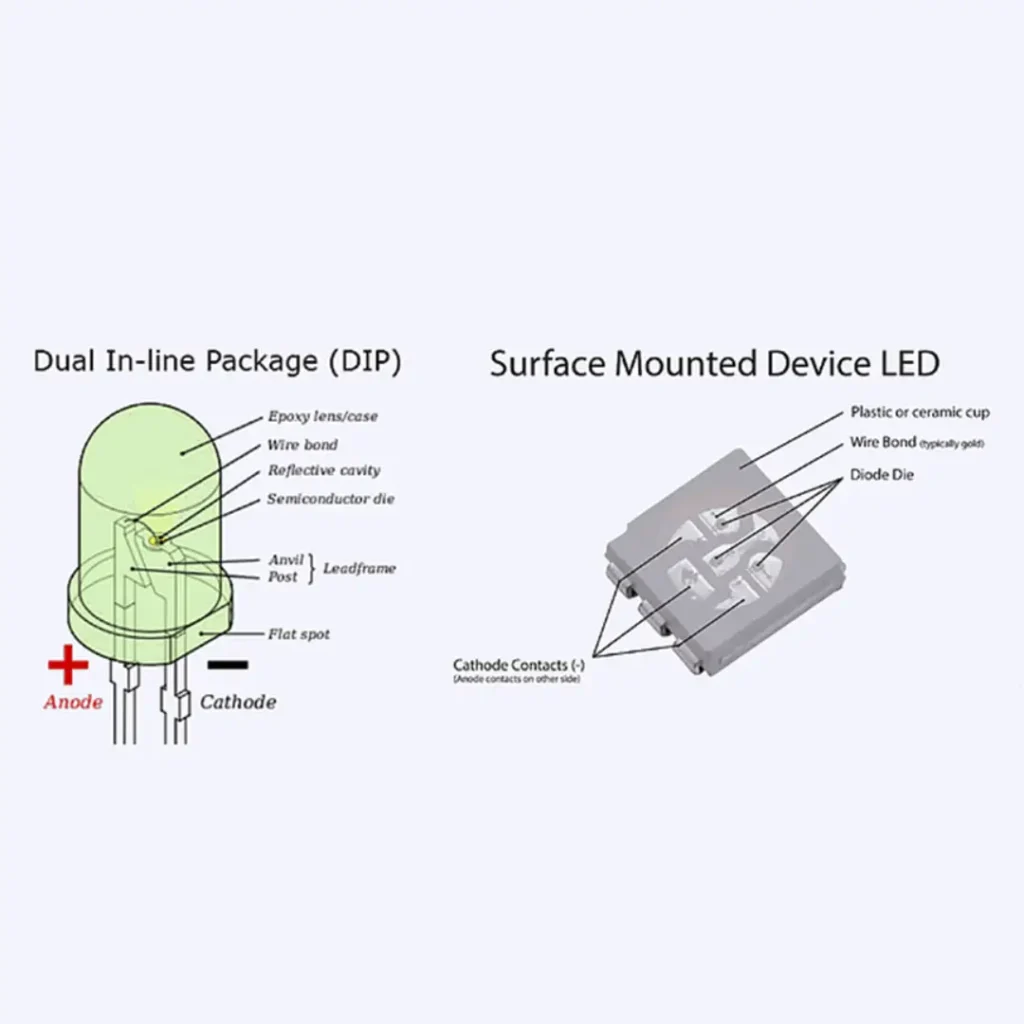
The structure of DIP LEDs is relatively simple and consists of four main parts: the LED chip, metal pins, encapsulation resin, and support frame.
- The metal pins are the defining feature. Usually made of copper, one end connects to the LED chip while the other end is inserted into the PCB and soldered, serving both electrical and mechanical functions.
- The encapsulation resin (typically epoxy) surrounds the chip and the base of the pins, protecting the chip and focusing the light. DIP LEDs are commonly round or square, and their casing is often transparent or semi-transparent.
Because the pins are long, DIP LEDs dissipate heat mainly through the pins. Heat travels from the chip to the pins and then into the PCB, which limits thermal efficiency. The long pins also make the LED physically large, preventing high-density integration.
SMD LEDs have a more compact and precise structure, consisting of LED chip, substrate, conductive adhesive/gold wire, encapsulation resin, and pads.
- Instead of long pins, SMD LEDs have pads on the bottom of the substrate, which connect to the chip via conductive adhesive or gold wire.
- The encapsulation resin is smaller, providing better protection and a closer fit to the PCB surface.
- The substrate is usually metal or ceramic, supporting the chip and aiding in heat dissipation. This gives SMD LEDs higher thermal efficiency compared to DIP LEDs.
SMD LEDs can also integrate multiple chips. For example, the common 5050 RGB SMD LED houses red, green, and blue chips in a single package for multicolor lighting. In contrast, most DIP LEDs are single-chip and less suitable for high-density integration.
Manufacturing Process Differences
The manufacturing process for DIP LEDs is relatively straightforward. The typical steps are: chip bonding → gold wire connection → encapsulation resin → pin trimming → testing.
- Because the process is simple, early LED manufacturers could mass-produce DIP LEDs at a relatively low cost.
- However, the mounting process is more cumbersome. The pins must be inserted into PCB holes either manually or by machine, followed by wave soldering. This not only reduces efficiency but also risks bent pins or poor solder joints, making DIP LEDs less suitable for large-scale, high-density production.
SMD LEDs, on the other hand, involve a more complex process: chip bonding → conductive adhesive/gold wire connection → resin molding → pad processing → laser cutting → testing.
- The main challenge lies in high-precision placement. Specialized SMT machines are used to accurately mount SMD LEDs onto the PCB surface, followed by reflow soldering.
- Automation makes production 3–5 times faster than DIP LEDs, making SMD LEDs ideal for large-scale, high-density manufacturing.
However, the higher process complexity requires advanced equipment and technical expertise, especially for multi-chip SMD LEDs. Initial production costs are higher than DIP LEDs, but with technology becoming widespread, mid- and low-end SMD LEDs now cost roughly the same as DIP LEDs.
Core Performance Differences
Performance differences are one of the most important distinctions between DIP and SMD LEDs and should be a key consideration when choosing between them. Let’s compare them across four key dimensions: brightness, viewing angle, thermal performance, and lifespan.
- Brightness:
DIP LEDs excel in “high single-point brightness.” Their encapsulation often focuses light, producing 100–500 mcd per LED, which is ideal for applications that need strong, concentrated light, such as traffic signals or outdoor high-power indicators.
SMD LEDs have lower single-point brightness, but their small size allows high-density placement. Combining multiple LEDs can achieve overall brightness that easily surpasses DIP LEDs, making them perfect for indoor ceiling lights and LED strips.
- Viewing Angle:
DIP LEDs have a narrower viewing angle, usually 70°–100°, producing focused light ideal for directional applications.
SMD LEDs offer a wider viewing angle, up to 120°–180°, providing more even light distribution, which is better for large-area illumination, like TV backlights, indoor lighting, and advertising screens.
- Thermal Performance:
SMD LEDs dissipate heat more efficiently. Their metal or ceramic substrate conducts heat from the chip to the PCB directly, reducing thermal buildup.
DIP LEDs rely mainly on pins for heat dissipation, which is less efficient. Prolonged use can lead to chip overheating and accelerated light decay. For high-power LEDs, the thermal advantage of SMD LEDs is particularly noticeable, helping extend product lifespan.
- Lifespan:
SMD LEDs generally last longer, around 50,000–100,000 hours, thanks to better heat dissipation and lower chip operating temperatures.
DIP LEDs typically last 20,000–50,000 hours. Poor heat management accelerates chip aging and light decay, reducing their usable life.
Appearance and Size Differences
The physical size and appearance of LEDs are the most obvious differences between DIP and SMD, and they directly affect device design:
DIP LEDs are relatively large. Common sizes are 5mm and 8mm, with long pins that protrude from the back of the PCB after soldering. This makes the PCB surface uneven and unsuitable for slim or compact devices. DIP LEDs typically have simple shapes—round or square—and colors are mostly transparent, red, or green, with limited aesthetic appeal.
SMD LEDs are very small. Common sizes include 0805, 3528, and 5050, with a thickness of only 0.3–1mm. They have no long pins and sit flush with the PCB after soldering, allowing for thinner, smaller devices. SMD LEDs come in a variety of shapes and colors and can even achieve full RGB color, making them more visually appealing.
Application Scenarios: No “Best,” Only the Most Suitable
Once you understand the core differences, the key is knowing when to choose DIP and when to choose SMD. The choice largely depends on factors like the environment, brightness requirements, and device size. Let’s break it down with real-world examples:
Typical Applications for DIP LEDs
DIP LEDs offer high single-point brightness, stability, and durability, making them suitable for outdoor, high-brightness, and high-reliability applications:
- Outdoor displays and lighting: Billboards, traffic lights, streetlights, and landscape lights. Early outdoor LED screens almost always used DIP LEDs because they can withstand sunlight, rain, and high temperatures, with brightness visible from a distance.
- High-power indicators: Industrial equipment indicators, machine tool lights, and early car taillights. DIP LEDs provide strong light to ensure visibility in critical situations.
- Low-end electronics: Old remote controls, radios, and toy indicators. DIP LEDs are cost-effective and stable where size and aesthetics are not a priority.
Typical Applications for SMD LEDs
SMD LEDs excel in small, thin, high-density, and indoor applications:
- Consumer electronics: Smartphones, tablets, and computer backlights, as well as smartwatches and wireless earbuds. SMD LEDs are perfect for compact devices that require slim form factors.
- Indoor lighting: Ceiling lights, downlights, LED strips, and panel lights. SMD LEDs provide wide-angle, even illumination, and their small size maintains aesthetic design.
- High-end displays: TVs, monitors, indoor HD screens, and stage displays. SMD LEDs enable high-density, full-color designs for clear and detailed visuals.
- Smart devices: Smart home products and wearable devices. Their compact size, low power consumption, and aesthetic flexibility meet the design needs of modern electronics.
How to Choose Smartly
Performance and applications aside, cost is also a key factor:
- Initial cost: DIP LEDs are cheaper to manufacture and purchase, especially for low-power versions—they can cost only 50–70% of comparable SMD LEDs. SMD LEDs, particularly high-end multi-chip types, are more expensive upfront.
- Long-term cost: SMD LEDs are more cost-efficient over time because of their longer lifespan and slower light decay, reducing maintenance. DIP LEDs have a shorter lifespan and require more frequent replacement, which is especially costly in outdoor installations.
- Value: For short-term use, or when size and appearance are not important and budgets are limited, DIP LEDs offer better cost-performance. For long-term use, compact devices, or applications demanding high stability and aesthetics, SMD LEDs provide better value despite higher initial costs.
Summary
In essence, DIP and SMD LEDs are two packaging technologies suited for different scenarios—neither is absolutely better.
- DIP holds its ground in outdoor, high-brightness applications with stability and strong light, remaining indispensable.
- SMD leads in consumer electronics and indoor lighting with its compact, high-density design, becoming the current mainstream.
Quick selection rule:
- Outdoor, high-brightness, long-distance visibility, limited budget → choose DIP.
- Indoor lighting, small devices, high-density integration → choose SMD.
Following this principle, and combining it with the detailed comparisons above, you can confidently pick the LED packaging that fits your project.
Additionally, when choosing a PCB assembly service, it’s wise to select manufacturers that offer both SMT and THT services. Even if you don’t need both now, having full capabilities will help with future design upgrades or changes.